Joseph Davidovits
The French materials chemist Joseph Davidovits coined the term geopolymer in the late 1970s and founded the Geopolymer Institute in northern France. Every modern alkali activated binder rests on the chemistry he established, and the field exists in its present form because of his work.
The larger claim came out of the same research. Studying the composition of stone at Giza, Davidovits proposed in 1979 that many of the blocks were not carved at all but cast in place, poured as a mineral slurry that set into artificial stone. He extended the argument to sites across South America, the Pacific and the Mediterranean, and spent four decades assembling the microstructural evidence behind it.
The response from mainstream archaeology has been to set the question aside rather than take it up. That is not difficult to understand. A finding that ancient builders synthesised their own stone would require rewriting the accepted account of how these monuments were made, over what timescale, and what the cultures that made them actually knew. The disciplines that would have to do the rewriting are the ones best placed to leave the question alone.
We build on his chemistry, and we take his archaeology seriously.
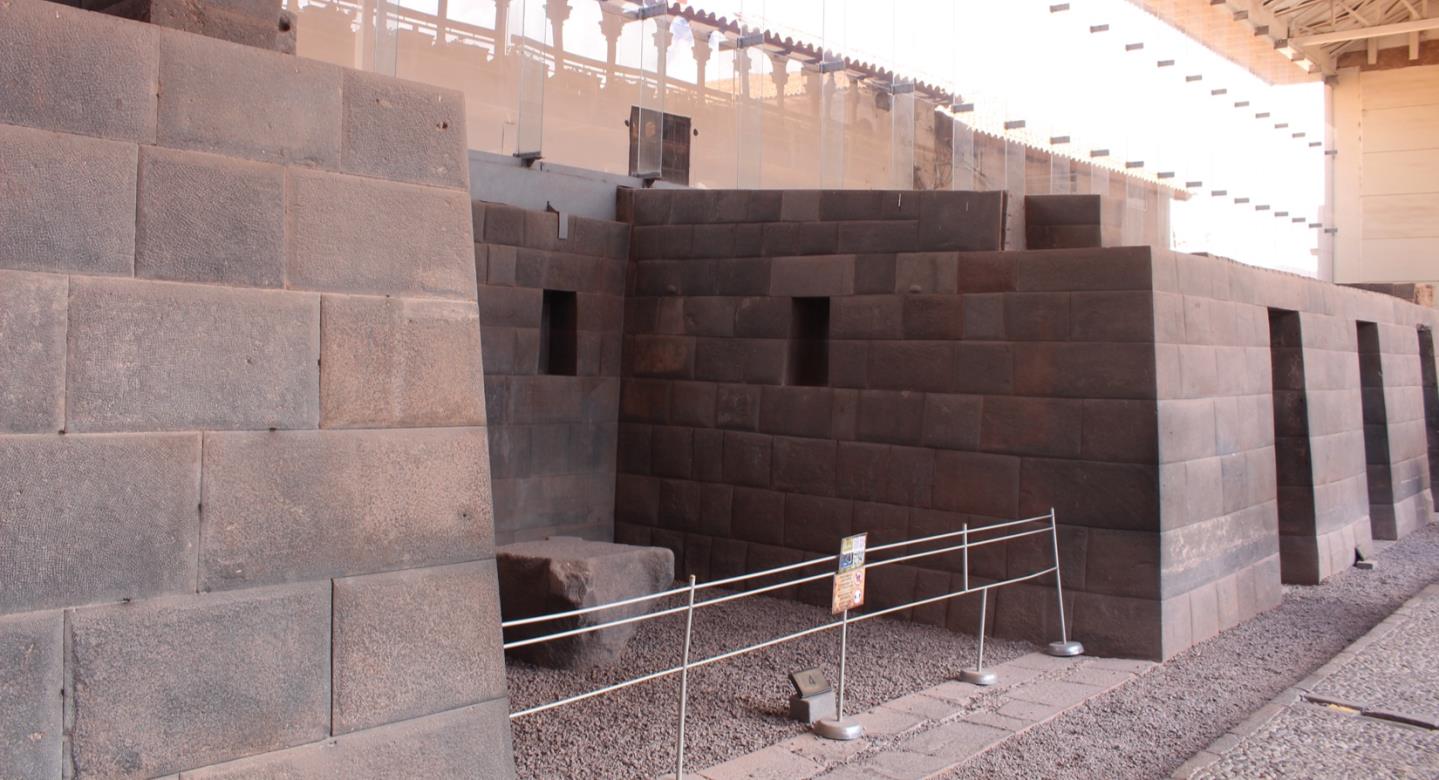
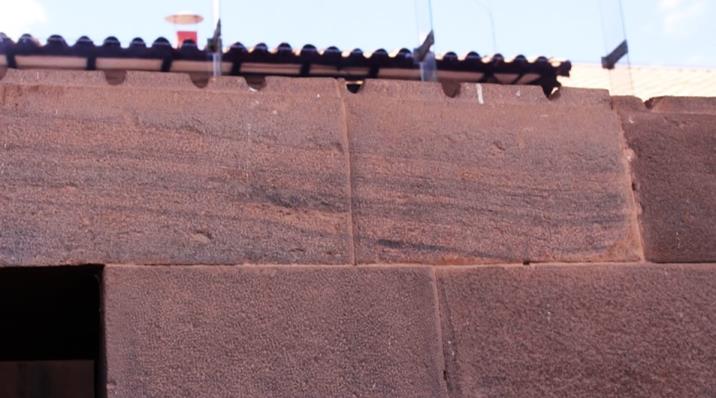
Qorikancha, Cusco, Peru. The ashlar exterior of the temple. The material samples analyzed below were taken from a naturally weathered break beside the second doorway.Photograph by Trevor Hawke, August 2025
They cast their stone
The case does not rest on one site, one method or one researcher. Independent analyses across two continents keep returning the same signature: chemistry that does not match the quarry, microstructure that is amorphous rather than crystalline, and surface behavior that belongs to a material which was once wet.
Peer reviewed
Giza
Electron microscopy of fifteen pyramid samples found ratios of calcium and magnesium that do not match the nearby quarries, alongside substantial regions of amorphous structure. Neither belongs in stone cut from bedrock. Both belong in a mix.
Barsoum, Ganguly and Hug, Journal of the American Ceramic Society, 2006
Field analysis, 2026
Cusco
Four samples from the Qorikancha temple and Huaca Sapantiana returned silicon to aluminium ratios between 2.17 and 3.12, the range that defines a poly sialate network, with a calcium to silicon ratio fixed at 0.12 across both sites. That level of consistency across geographically separate structures describes a recipe, not a geology.
Hawke, Evidence of Geopolymer Concrete in Megalithic Architecture of Cusco, 2026
Foundational
Tiwanaku and Puma Punku
Analysis of the H blocks at Tiwanaku found organic chemistry preserved inside the internal microstructure. Nothing organic survives the formation of an igneous rock. Whatever those blocks are, they did not cool out of a volcano.
Davidovits, Huaman and Davidovits, Ceramics International, 2019
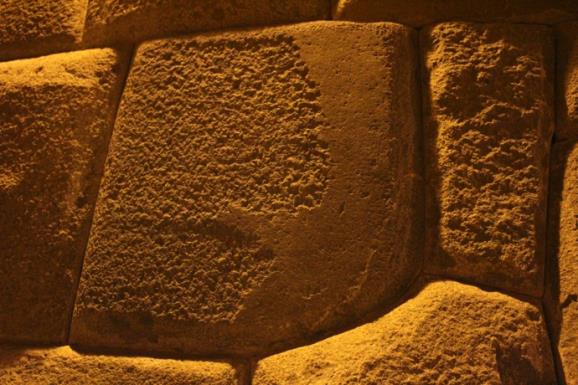
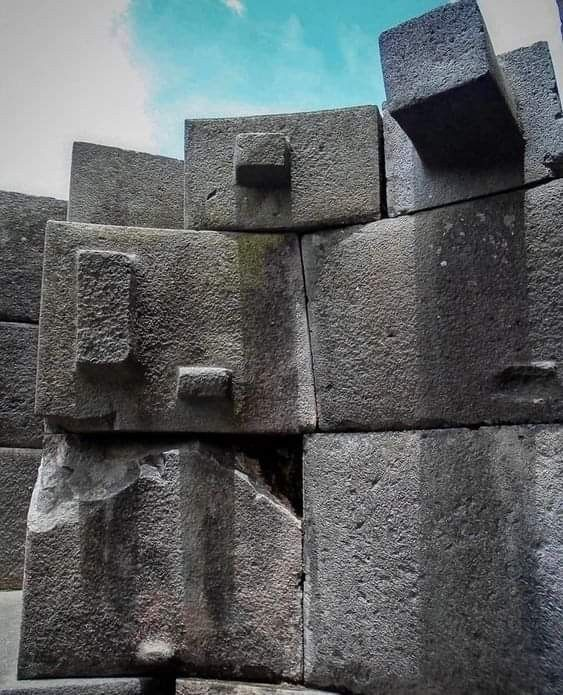
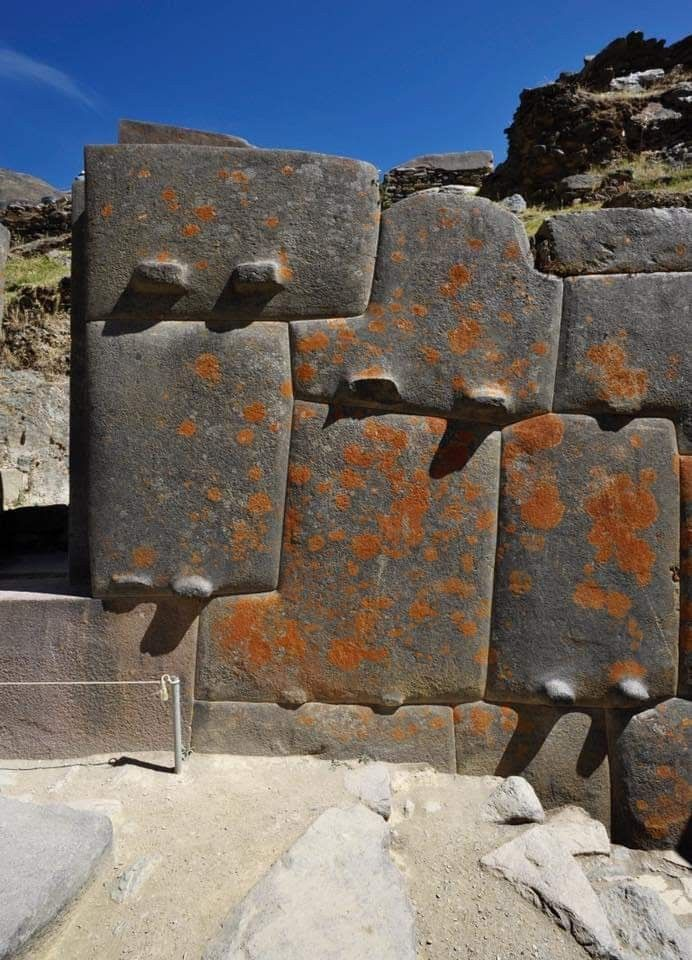
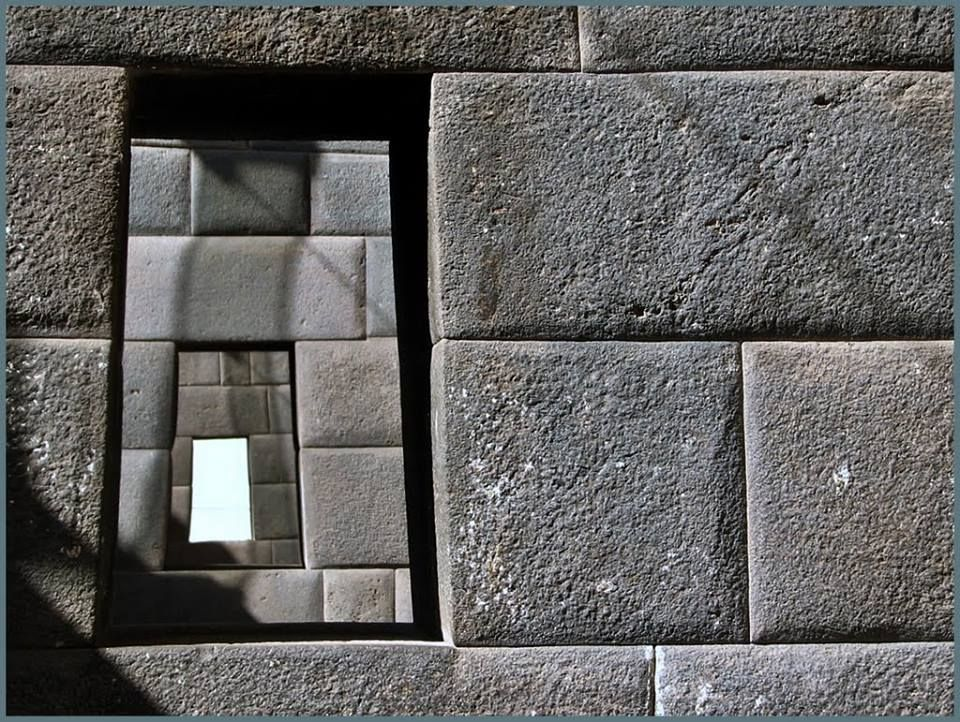
Three things at Cusco are visible without an instrument. Flow lamination runs continuously across a doorway lintel from one block into the next, which cannot happen in two stones cut separately from a quarry face. Trowel marks cross the exposed faces of the polygonal blocks, a finish that belongs to material worked while soft. And small protrusions sit at the bottom edge of block after block along the same course, positioned where fluid would collect and drain rather than where a rope would balance a load.
Inca Roca Palace, Hatunrumiyoc, Cusco, Peru. On the left, a single flow pattern crossing the joint between two blocks. On the right, tool marks running across a face that natural andesite outcrops do not carry.Photographs by Trevor Hawke, August 2025
The protrusions. Small bosses sit low on block after block along the same course, in the position fluid would gather and drain rather than where a rope would balance a load.
The Mediterranean branch
Roman concrete is the one case that made it into the journals without resistance, and it is a close relative rather than the same thing. Geopolymer proper is low in calcium and builds a sodium aluminosilicate network that behaves like a zeolite. Roman concrete is a lime pozzolan, rich in calcium, building a calcium aluminosilicate hydrate instead. Both belong to the family of alkali activated aluminosilicate binders, on opposite branches of it.
Davidovits made the connection himself. Nuclear magnetic resonance data from Roman cement artifacts indicates the reaction products are not purely lime carbonation, but include aluminosilicate structures formed by a chemical reaction between calcined clay and volcanic ash. Rome was doing a version of the same thing, with the calcium rich ingredients the Bay of Naples handed it.
The famous self healing belongs to the Roman side specifically. Lime clasts produced by hot mixing sit dormant in the matrix, and when a crack forms and water reaches one, it dissolves and recrystallises inside the crack and seals it. A team at MIT identified the mechanism in 2023 and a newly excavated site at Pompeii confirmed it in 2025.
Recurrence in stone
It would be tidier if this were a single tradition handed down from one civilisation to the next, and it is not. Giza precedes Roman concrete by more than two thousand years. Tiwanaku, Rapa Nui and Cusco all come long after Rome fell. There is no line to draw.
What there is instead is the same solution arriving separately, in places that had no contact with one another, whenever a culture understood its own ground well enough. Each one used what was locally to hand: Nile limestone, Neapolitan volcanic ash, Andean tuff and salt brine, Pacific basalt, Chinese clay and rice starch. Different ingredients, the same chemistry underneath. Each site answers a different question, and it is worth being precise about which.
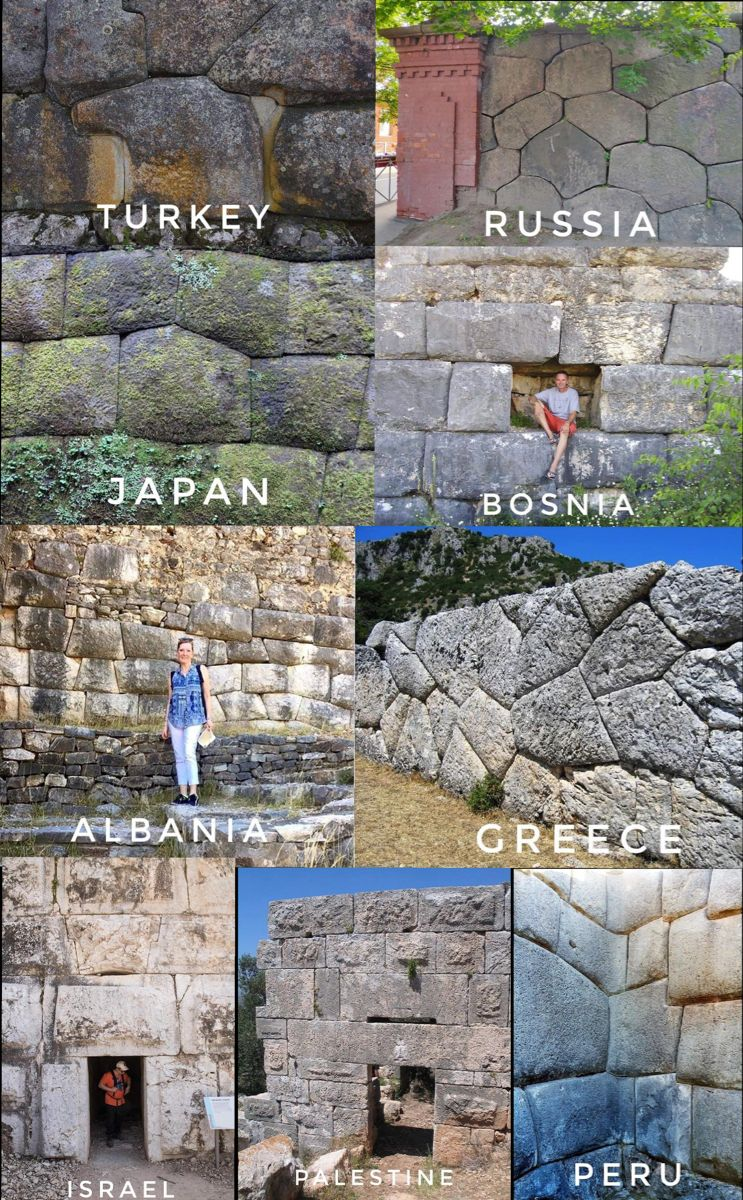
The same wall, nine countries. Turkey, Russia, Japan, Bosnia, Albania, Greece, Israel, Palestine, Peru. Interlocking polygonal blocks with rounded, pillowed faces and joints that close without mortar, built by cultures separated by oceans and by thousands of years.
about 2600 BCE, standing 4,600 years
GIZA, EGYPT
The Great Pyramids
Electron microscopy of fifteen samples found calcium and magnesium ratios that do not match the nearby quarries, alongside substantial amorphous regions. Paleomagnetic study of stones at Khufu and Khafre pointed the same way.
Barsoum, Ganguly and Hug, 2006. Túnyi and El-hemaly, Europhysics News, 2012
about 1350 BCE, standing 3,400 years
THEBES, EGYPT
The second act
Agglomerated stone returns to Egypt under Amenhotep III, roughly thirteen hundred years after the Great Pyramids. A technology that is forgotten and recovered is a technology, not a coincidence.
Davidovits, Geopolymer Institute
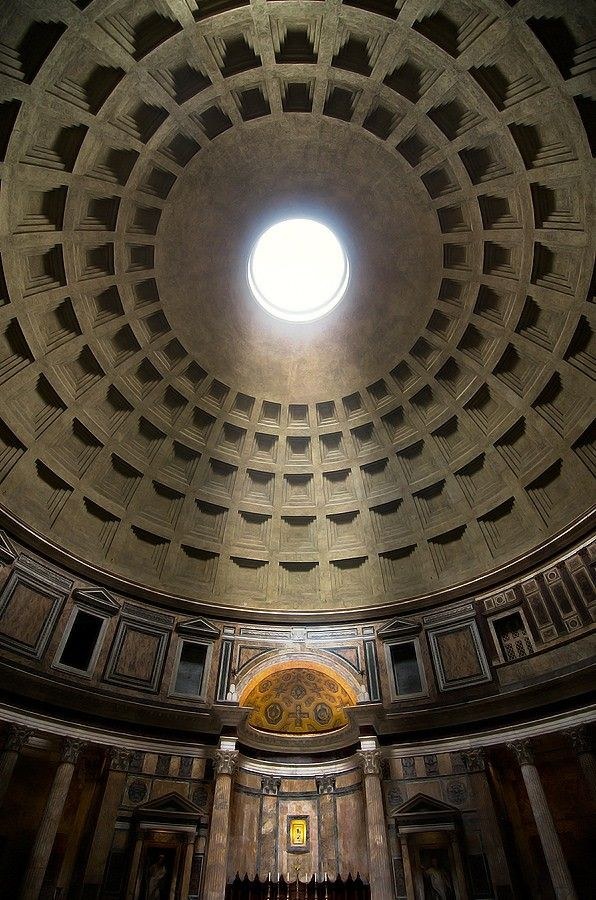
200 BCE to 400 CE, the Pantheon standing 1,900 years
THE ROMAN MEDITERRANEAN
Opus caementicium
The calcium rich branch of the same family. Nuclear magnetic resonance of Roman cement artifacts shows aluminosilicate structures formed from calcined clay and volcanic ash, not lime carbonation alone. The Pantheon dome is still the largest unreinforced concrete dome on earth.
Davidovits and Davidovits, 1999
about 600 CE, standing 1,400 years
TIWANAKU AND PUMA PUNKU, BOLIVIA
Organic matter inside volcanic stone
Scanning electron microscopy of the gray andesite H blocks found carbon and nitrogen inside the matrix. Organic chemistry cannot survive the formation of a volcanic rock. The binder appears to have been organo mineral, built from acids drawn out of local plants.
Davidovits, Huaman and Davidovits, Ceramics International, 2019
1200 to 1600 CE
RAPA NUI, SOUTH PACIFIC
The moai and the Vinapu wall
A 1973 UNESCO analysis reported fossilized microorganisms and bacteria contained in the statues, with volcanic tuff sand at the base of the ahu platforms. Arriving Polynesians appear to have adapted the technique already present in the Vinapu wall and developed it into a statue form of their own.
Davidovits, Ancient Geopolymers in South America and Easter Island, Springer, 2024
about 1450 CE, and shaken hard twice since
CUSCO, PERU
Qorikancha and Sacsayhuaman
Four samples returned silicon to aluminium ratios between 2.17 and 3.12 with a calcium to silicon ratio fixed at 0.12 across two separate sites. Flow lamination crosses a lintel joint from one block into the next. Cusco is not the oldest site here. It is the most tested, which is a different and in some ways more useful thing.
Hawke, Harmonic Research Group, 2026
about 1770 CE
ANHUI, CHINA
The ternary clay composite
Lime, clay and sand worked together with sticky rice, used across Chinese construction for centuries. Nanoindentation of a tomb sample found geopolymer in the binder matrix almost identical in nanomechanical performance to modern alkali activated fly ash geopolymer. After two and a half centuries the sample showed no sign of deterioration.
Materials, 2016
Set them side by side and each one answers something the others cannot.
Age is answered at Giza. The casing has taken four and a half thousand years of Nile flooding and was stripped by an earthquake in 1303, and the cores are still standing. Rome adds nineteen centuries of an unreinforced dome held over a city. Tiwanaku adds fourteen.
Seismic survival is answered at Cusco, and it is answered better there than anywhere, because what matters in an earthquake is events survived rather than years elapsed. Five centuries is not long by the standards of this list. But in 1650 a quake destroyed the Church of Santo Domingo where it stood on the Qorikancha wall, and in 1950 more than half the city came down and destroyed the rebuilt church a second time, and both times the wall underneath did not move. Two direct hits, two collapses on top of it, no damage below. A thousand quiet years somewhere stable would tell us less.
The ocean is answered at Rapa Nui. In 1960 a tsunami generated off Chile crossed the Pacific and threw the moai at Ahu Tongariki inland. They were recovered and re erected, because being picked up by an ocean and put down somewhere else had not broken them.
Floods, earthquakes, tsunami, fire and four thousand years of weather, across five continents, in a material a modern engineer is told to be cautious about. No structure standing today that was built in the last hundred years is expected to do anything remotely like this.
The question nobody can answer yet
How old is Sacsayhuaman? The imperial Inca building program runs from about 1438, and archaeologists have identified earlier Killke period work at the same site reaching back toward 900. The megalithic polygonal courses look to many eyes like a different technology from the smaller work sitting on top of them. Nobody can settle it, because there has never been anything in the stone to date. You cannot radiocarbon date a carved rock. The mineral is as old as the mountain it came from.
A cast rock is a different matter. If these blocks were poured rather than quarried, they contain organic material that entered the mix on the day it was made. Puma Punku’s andesite holds carbon and nitrogen. The Sapantiana sample holds a fossilized micro arthropod. Both papers end at the same place: carbon 14 dating of those inclusions would give an absolute date, not for the quarry, but for the pour.
That test has not been run. It is not expensive. It would date the moment somebody mixed the batch, and it is available only because the stone is artificial. The artificial stone finding is the thing that makes the age question answerable at all.